


Introduction to Burma Teak Wood Logs
For commercial sawmills, heavy-timber structural engineers, and large-scale architectural contractors, importing unprocessed Burma teak wood logs represents the strategic apex of the global hardwood supply chain. By securing the raw material in its absolute fundamental log form, industrial buyers gain total control over the raw timber conversion process, allowing for the customized extraction of premium Tectona grandis wood tailored to highly specific dimensional requirements. Genuine Burmese teak wood, harvested from mature, naturally occurring forest reserves, delivers an unparalleled density and a straight, predictable grain structure that plantation-grown alternatives cannot yield.
Sourcing raw Burma teak wood logs empowers commercial facilities to maximize their board-foot yield through strategic milling, whether targeting massive structural beams, precision quarter-sawn decking, or wide-plank aesthetic veneers. The wood encased within these logs is globally recognized for its uncompromising hydrostatic resistance, exceptional load-bearing capacity, and low volumetric shrinkage. For industries that require massive volumes of flawless, high-density hardwood that will perform under severe mechanical stress and relentless elemental exposure, unprocessed Burmese teak wood logs are the definitive raw material investment.
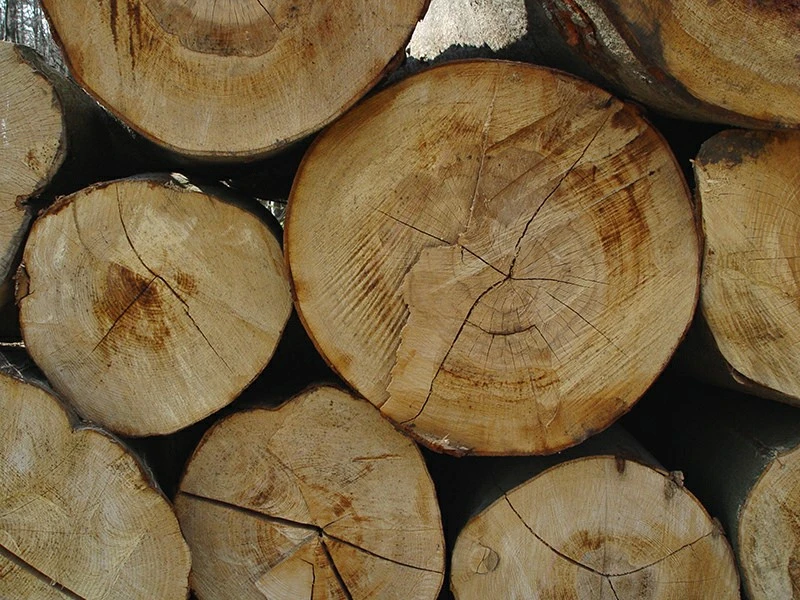
Core Processing Advantages and Material Properties
The decision to procure whole Burma teak wood logs over pre-milled lumber is driven by the unique mechanical properties of the wood and the economic advantages of custom commercial milling. The following technical specifications highlight the superiority of this raw timber:
Optimized Heartwood-to-Sapwood Yield
The foremost advantage of old-growth Burmese logs is the sheer volume of usable heartwood. Due to the extended maturation period of the tree, the highly durable, oil-rich heartwood constitutes the vast majority of the log's cross-section. This allows sawmills to execute complex cutting geometries-such as rift-sawing or quarter-sawing-while experiencing minimal waste from the softer, less resilient sapwood exterior, dramatically improving the overall return on investment per cubic meter.
Self-Lubricating Machining Characteristics
The cellular matrix of Burma teak wood is heavily saturated with natural oleoresins and rubber. During the intensive breakdown of the logs, these internal oils act as a natural lubricant against industrial bandsaw blades. While the silica content requires hardened tooling, the internal lubrication prevents the wood from burning or binding during high-speed commercial milling, resulting in an exceptionally smooth surface off the blade that requires minimal secondary planing.
Superior Mechanical Compression and Density Metrics
Lumber extracted directly from these premium wood logs exhibits elite structural metrics. With an average dried weight of 655 kg/m³ (41 lbs/ft³) and a remarkably high crushing strength, the wood is engineered by nature to withstand extreme mechanical loads. Its modulus of elasticity allows it to absorb intense kinetic shock without fracturing, making the heavy lumber derived from these logs ideal for load-bearing civil engineering applications.
Predictable Volumetric Stability Post-Milling
Unlike many tropical hardwoods that warp violently upon being sawn from the log, Burmese teak wood maintains exceptional dimensional integrity. Because the moisture exchange is inherently regulated by the wood's dense oil concentration, freshly sawn green lumber extracted from these logs dries with a very low coefficient of shrinkage. This stability ensures that large-scale structural timbers remain plumb and true throughout the air-drying and final acclimatization phases.
Heavy Industrial and Commercial Applications
The primary consumers of raw Burma teak wood logs are specialized industrial facilities that process the timber for heavy-duty and precision applications where failure is unacceptable.
Commercial Sawmilling and Custom Wood Production
Large-scale timber processors import these logs to generate custom inventories of rough-sawn lumber. By controlling the breakdown process, mills can supply distinct markets simultaneously-diverting the highest-grade, straight-grain outer cuts to the luxury veneer industry, while utilizing the dense, unyielding core for heavy structural planks and heavy-duty industrial flooring.
Civil Engineering and Heavy Infrastructure
The massive dimensions of raw teak wood logs make them indispensable for heavy civil engineering. They are frequently milled into oversized structural timbers for the construction of coastal boardwalks, marine piling, heavy-timber bridges, and lock gates. In these applications, the wood's natural immunity to aquatic decay and structural rot eliminates the need for toxic pressure treatments, making it an environmentally stable choice for aquatic infrastructure.
Commercial and Naval Boat Building
Beyond luxury yachts, robust Burma teak wood is utilized in the construction of commercial marine vessels, working trawlers, and heavy-duty naval applications. Logs are processed into thick hull planking, heavy structural ribs, and impact-resistant rubbing strakes. The wood's ability to resist saltwater corrosion and withstand the brutal physical impacts of commercial maritime operations makes it a critical marine engineering material.
High-Volume Architectural Components
Industrial manufacturers of architectural components utilize these logs to produce massive quantities of standardized, high-performance building materials. The wood is systematically milled into weather-proof exterior cladding, heavy solid-wood doors, and custom window framing systems for high-end commercial real estate developments, ensuring lifetime durability and zero moisture-induced expansion.
Frequently Asked Questions (FAQ) About Wood Log Processing
Q1: How is the volume of these raw teak wood logs calculated for commercial purchasing?
A: In the international commercial timber trade, the volume of raw round logs is typically calculated using the Hoppus cubic measure or true cubic meter formulas (using the average mid-girth and length). This measurement accounts for the tapering of the log and provides buyers with an accurate estimation of the actual usable wood volume prior to milling.
Q2: Should the raw logs be processed immediately upon arrival, or stored?
A: While the logs are highly resilient due to their intact bark and end-sealing, it is generally recommended to process them into rough-sawn lumber or cants as soon as logistically possible. Milling the wood logs early allows the resulting lumber to begin a controlled, uniform air-drying process, significantly reducing the risk of deep end-checking or internal tension wood splitting.
Q3: What is the optimal cutting strategy for Burmese teak wood logs?
A: The cutting strategy is dictated by the end-user's requirements. For marine decking and luxury flooring, quarter-sawing is the optimal method, as it yields lumber with vertical grain that offers the highest dimensional stability and uniform wear. For maximum volume yield and general structural use, plain-sawn or through-and-through cutting is highly efficient.
Q4: Does the wood require chemical treatment after being sawn from the log?
A: No. One of the defining industrial advantages of authentic Burma teak wood is its zero-chemical requirement. The natural oils, rubber, and silica embedded within the heartwood provide absolute, lifelong protection against termites, marine borers, and fungal rot. The wood is naturally preserved the moment it is cut.
Q5: How do sawmills manage the high silica content during the breakdown of the log?
A: Because the silica within the wood acts as an abrasive, commercial mills processing these logs must deploy specialized tooling. Industrial bandsaws fitted with Stellite-tipped or carbide-tipped teeth are standard protocol. These hardened alloys maintain their cutting edge significantly longer than standard steel, ensuring precise, continuous processing of the raw logs.